
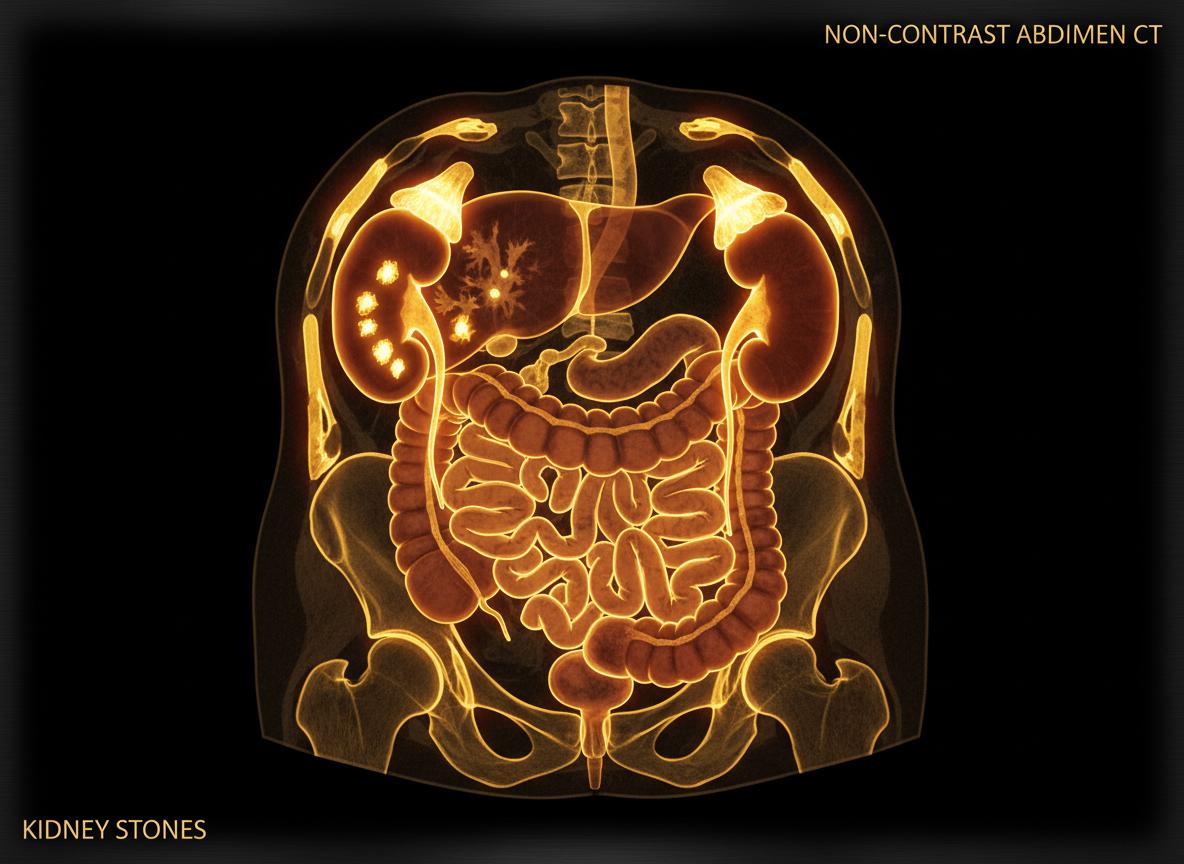
If you have ever experienced the sudden, sharp, wave-like pain of a kidney stone — usually in the side or lower back, sometimes radiating into the groin — your doctor most likely sent you for a quick test called an NCCT KUB. KUB stands for Kidneys, Ureters and Bladder.
Why NCCT is preferred over ultrasound
Ultrasound is a useful first-line test, but it can miss small stones (especially in the ureter) and depends heavily on the patient's body type. NCCT, on the other hand, identifies stones as small as 1 to 2 mm anywhere in the urinary tract, gives precise location and size, and even helps the urologist predict how the stone is likely to behave — whether it can pass on its own or whether intervention is needed.
What the report tells your urologist
- Number, size and exact location of every stone.
- Hounsfield unit (density) — a clue to the type of stone.
- Any obstruction or back-pressure in the kidney.
- Other relevant findings in the abdomen.
How to prepare
Almost no preparation needed. You can eat and drink normally. No injection is given. The scan itself is over in less than a minute. Reports are typically available within a couple of hours, signed and annotated by .
Disclaimer: This article is general information and not medical advice. Please consult your doctor for guidance specific to your condition.